Industry
Smart cities and traffic
Highway and junction enforcement, with plate-linked evidence for traffic police.
Number-plate recognition
Automatic number-plate recognition (ANPR) tuned for Indian plates. It reads plates by day and night, detects helmet, triple-riding and wrong-way violations, and checks vehicles against a watchlist.
This is the Videolytical product for roads, gates and car parks. It combines number-plate recognition with vehicle analytics.
ANPR and Vehicle Intelligence finds the number plate in a camera's video, reads its characters and logs the result with the time and the gate.
It also analyses the vehicle itself: direction of travel, parking and vehicle class. At high-security gates it supports under-vehicle inspection.
It has three main uses.
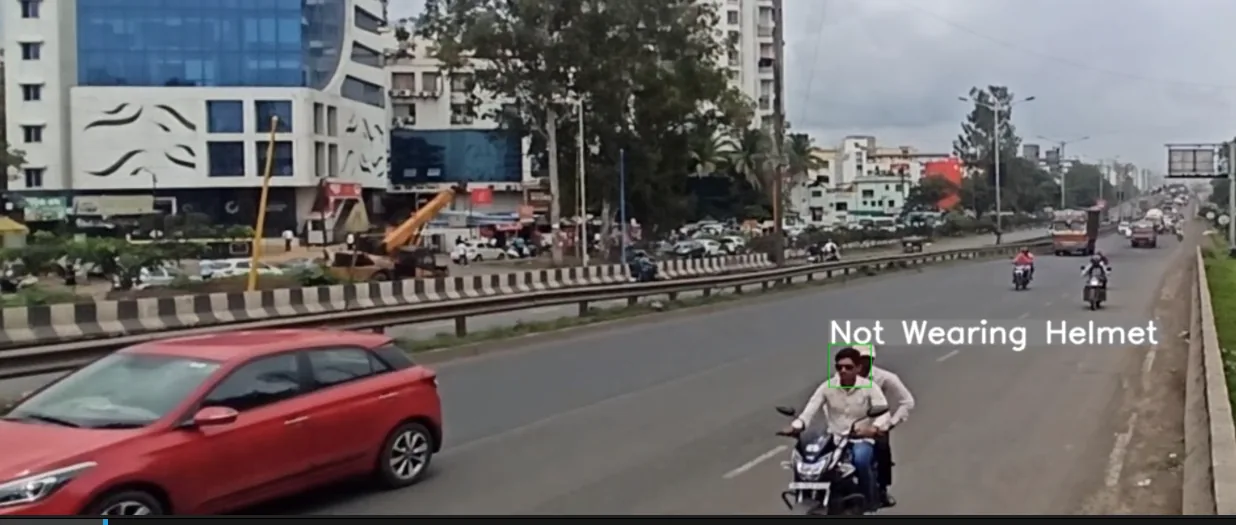
Helmet violation detected, city highway.
Capabilities are chosen camera by camera. A road, a gate and a car park each call for a different set.
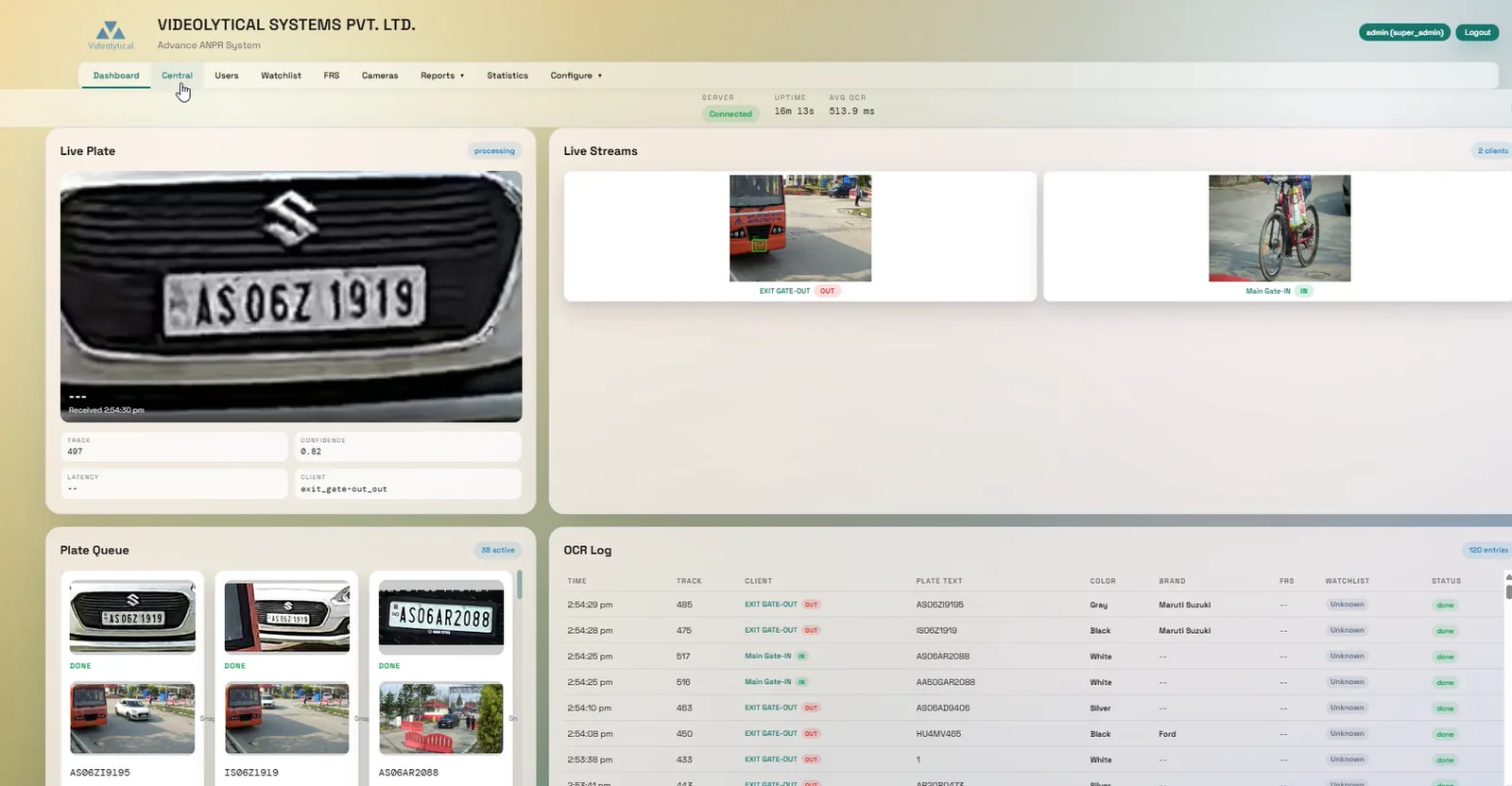
The ANPR dashboard, shown at the top of this page, follows a read from the camera stream to a row in the log.
Each entry and exit gate has its own live stream on the dashboard, tagged in or out.
The live plate view shows a close-up of the current plate. The plate queue shows a card for each read: a crop of the plate, a wider snapshot and the text that was read.
The OCR (optical character recognition) log adds a row for the read: time, gate, plate text, vehicle colour, vehicle brand and watchlist status.
Each read is checked against the watchlist of stolen or flagged vehicles. A match can be sent on as a real-time alert.
The same application has sections for users, the watchlist, cameras, reports, statistics and configuration.
These points hold for number-plate recognition in general. Raise them at the site survey and camera audit, the first step of a rollout.
ANPR and Vehicle Intelligence runs on the Videolytical platform: at the edge, on-premise or in the cloud. The options can be mixed in one estate.
| Deployment | Where it runs | What it offers | Typically suits |
|---|---|---|---|
| Edge | On the camera or an edge box | Keeps working without connectivity | Roadside and remote gate cameras with a limited network link |
| On-premise | GPU servers on the customer's network | Video stays inside the customer's network | Sites that must keep video on site, including air-gapped sites |
| Cloud | Cloud instances | Central dashboards, updates and storage | Estates with several sites, managed from one place |
The product uses the integration points of the Videolytical platform, so its events can reach systems your staff already use.
Typical deployments are on city roads and at transport hubs. These pages give the detail.
Industry
Highway and junction enforcement, with plate-linked evidence for traffic police.
Industry
Number-plate recognition for parking and pick-up zones at airports, railway stations and bus depots.
Solution
How violation detection and number-plate recognition work together on the road.
Case study
Rider helmet detection with ANPR evidence capture on highway cameras, by day and night.
Datasheet
Automatic number-plate recognition and vehicle analytics software for roads, gates and car parks. Tuned for Indian plates, by day and night.
| Product | Automatic number-plate recognition and vehicle analytics software |
|---|---|
| Plate recognition | Number plates read by day and night, tuned for Indian plates |
| Violation detection | No helmet, triple riding, wrong-way driving |
| Watchlist | Matching against a watchlist, or hotlist, of stolen or flagged vehicles |
| Vehicle analytics | Vehicle direction, parking and classification |
| Gate security | Under-vehicle inspection at high-security gates |
| Evidence | Plate-linked evidence records for e-challan workflows, which issue electronic traffic penalty notices |
| Operator dashboard | Live plate view, plate queue, live streams for entry and exit gates, and an optical character recognition (OCR) log |
| Log fields | Time, gate, plate text, vehicle colour, vehicle brand, watchlist status |
| Application sections | Users, Watchlist, Cameras, Reports, Statistics, Configure |
| Camera support | Existing IP cameras and network video recorders over ONVIF and RTSP |
| Alerts and interfaces | Alerts to the video management software (VMS) console, by SMS, by email or to a webhook. REST API and webhooks for events and metadata |
| Deployment | Edge, on-premise or cloud. The options can be mixed in one estate |
| Sizing | Network and GPU capacity are determined during the site survey |
Videolytical Systems Pvt. Ltd., 277, C Block, Sector 63, Noida, Uttar Pradesh, India. Sales and demos: sales@videolytical.com, +91 97160 05441.
It takes video from existing IP cameras and network video recorders over ONVIF and RTSP. Whether a particular camera gives readable plates depends on its position, angle and lighting. The site survey and camera audit, the first step of a rollout, looks at the cameras you have.
Yes. Number-plate recognition works by day and night. Night results depend on the camera and its lighting, so include a night clip from your own site when you evaluate.
No. At the edge or on servers at your site, the software keeps working without outside connectivity. With an on-premise deployment, video stays on your network. Cloud is an option for estates with several sites.
Each detected violation is linked to the plate read and becomes an evidence record for an e-challan workflow. Our smart city case study describes this for rider helmet detection on highway cameras.
That depends on the number of camera streams and on where the analytics run. In a rollout, network and GPU sizing follows the site survey and camera audit.
Ask for a live demo on your own footage, or send a sample clip from a road or gate camera. The usual next step is a pilot on a small set of cameras before scale-out.
Arrange a live demo, send a sample clip from a road or gate camera, or ask for an architecture and sizing discussion.