Solutions for security, safety and operations
Videolytical analytics modules, grouped by the job they do. Each section names the modules used, what the operator receives and where it applies.
- Cameras
- Existing IP cameras and recorders, over ONVIF and RTSP
- Runs on
- Edge devices, GPU servers or cloud instances
- Alerts go to
- Video management software (VMS), SMS, email or a webhook
Perimeter security
A long boundary is hard to watch by eye. Most movement near a fence is harmless, and the one crossing that matters is easy to miss.
- Intrusion detection
- A tripwire rule watches a line along a fence, wall or gate. A restricted-zone rule watches a marked area of the camera view. A crossing or an entry raises an alert.
- Loitering detection
- Flags a person who stays in a sensitive zone beyond a set time.
- At the gate
- Vehicle analytics adds under-vehicle inspection at high-security gates. Face recognition can match faces against a watchlist.
- False-alarm suppression
- False-alarm suppression is part of tuning for the site, which is done per camera. Our guide to reducing false alarms covers the general causes and controls.
- What the operator receives
- A real-time alert in the VMS console, by SMS, by email or to a webhook. In a control room, Command and Control shows cameras and alerts on a map.
- Where it applies
- Defence and paramilitary sites, industrial plants and warehouses at night, and retail premises after hours.
Crowd and people
When a concourse, platform or market fills up, the people in charge need to know while there is still time to act. It is hard to judge how full a space is getting from a wall of camera views.
Crowd monitoring raises alerts on density, flow and suspicious behaviour in a camera view. People counting records movement in both directions across a line at a gate or entrance. Loitering detection flags a person who lingers in a sensitive zone.
Alerts are raised in real time. In the airport deployment in our case studies, crowd analytics run on server GPUs and alerts reach the terminal control room with video bookmarks. A bookmark marks the moment in the recording.
Results depend on the camera view. A high, wide view of the space typically works better than a low camera that sees only the nearest people.
- Modules
- Crowd monitoring, people counting, loitering detection
- Operator receives
- Real-time alerts, and counts in and out
- Applies to
- Airport terminals, railway stations, bus depots, markets and public areas
Traffic enforcement
On a busy road, violations are too frequent to watch for by eye. A penalty also needs evidence that ties the offence to a vehicle.
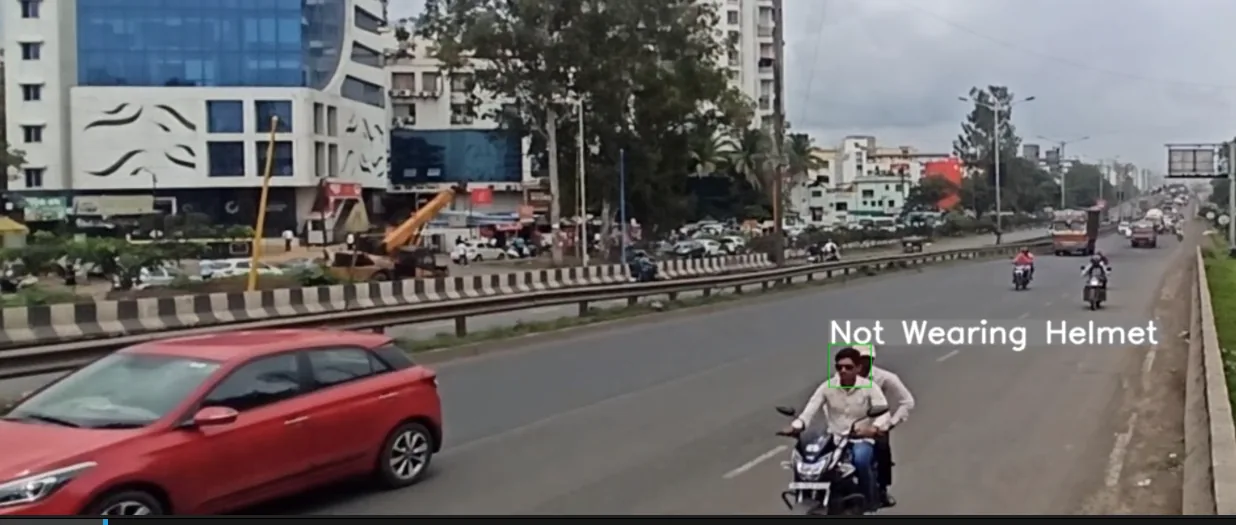
Helmet violation detected on a city highway camera.
- Modules
- Helmet and traffic violations, with number-plate recognition
- Operator receives
- An evidence record that links each violation to a plate
- Applies to
- Highway and junction enforcement by traffic police
- Hotlist
- Plates can be checked against a list of stolen or flagged vehicles
-
A violation is detected
Models detect riders without helmets, triple riding and wrong-way driving.
-
The number plate is read
Automatic number-plate recognition (ANPR) reads the plate by day and by night, and is tuned for Indian plates. Reliable reads depend on where the camera is placed, as our camera placement guide explains.
-
An evidence record is made
Each violation becomes a record that links the offence to the plate.
-
The record enters the penalty workflow
Records feed the e-challan workflow, the electronic traffic penalty notice process used by traffic police. Our traffic police case study describes one deployment.
Retail intelligence
Most stores already have cameras for security. The same video can show where shoppers walk, where they stop and when a billing queue is building.
- Heatmap and dwell time
- Shows movement density and dwell time across the floor, to help plan layouts, staffing and merchandising.
- People counting
- Counts people in and out at store entrances, in both directions.
- Queue-length alerts
- Warn when the queue at a billing counter grows, so that staff can respond, for example by opening another counter.
- Store security
- Intrusion detection watches the premises after hours. Loitering detection covers sensitive areas of the store.
- What the team receives
- Counts on live dashboards, heatmaps for planning, and real-time alerts for queues and intrusion.
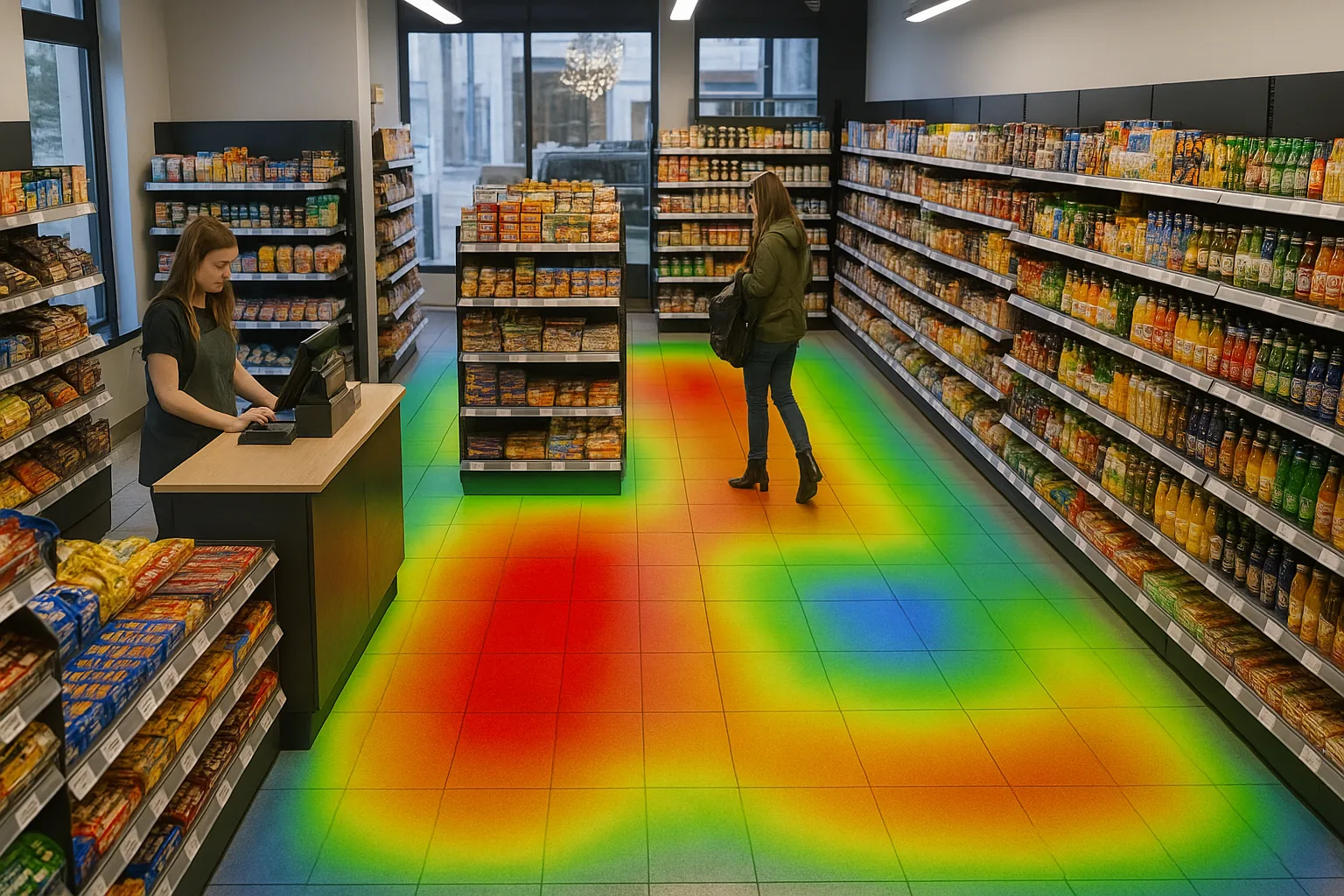
Illustration of a retail heatmap, not a product screen. In general, a heatmap colours the floor by how much movement each area sees.
Industrial safety
A safety officer cannot be at each workstation through a whole shift. A missing glove or a person in a danger zone is easy to miss between rounds.
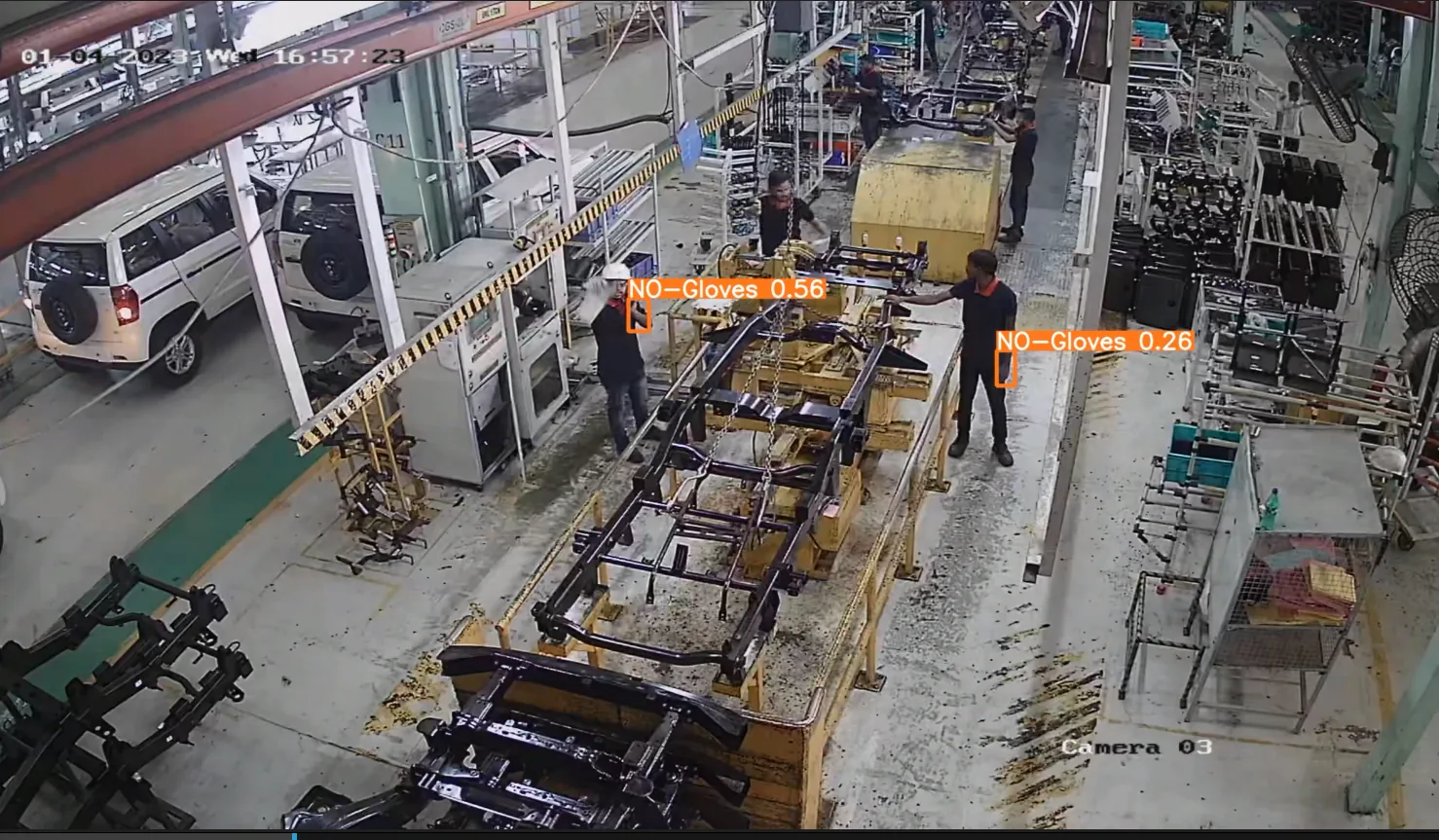
Equipment checks and danger-zone alerts
The PPE (personal protective equipment) compliance module checks for hard hats, vests, gloves and masks on production lines. Danger-zone alerts warn when a person enters a marked area on the shop floor. Fire and smoke detection watches for visible flames and smoke.
Alerts go to the VMS console, or by SMS or email to the people responsible for the area. Our guide to camera-based PPE monitoring explains the limits.
Smart warehousing
A warehouse needs a record of movement through its docks and gates. Hand tallies and gate registers are slow to check.
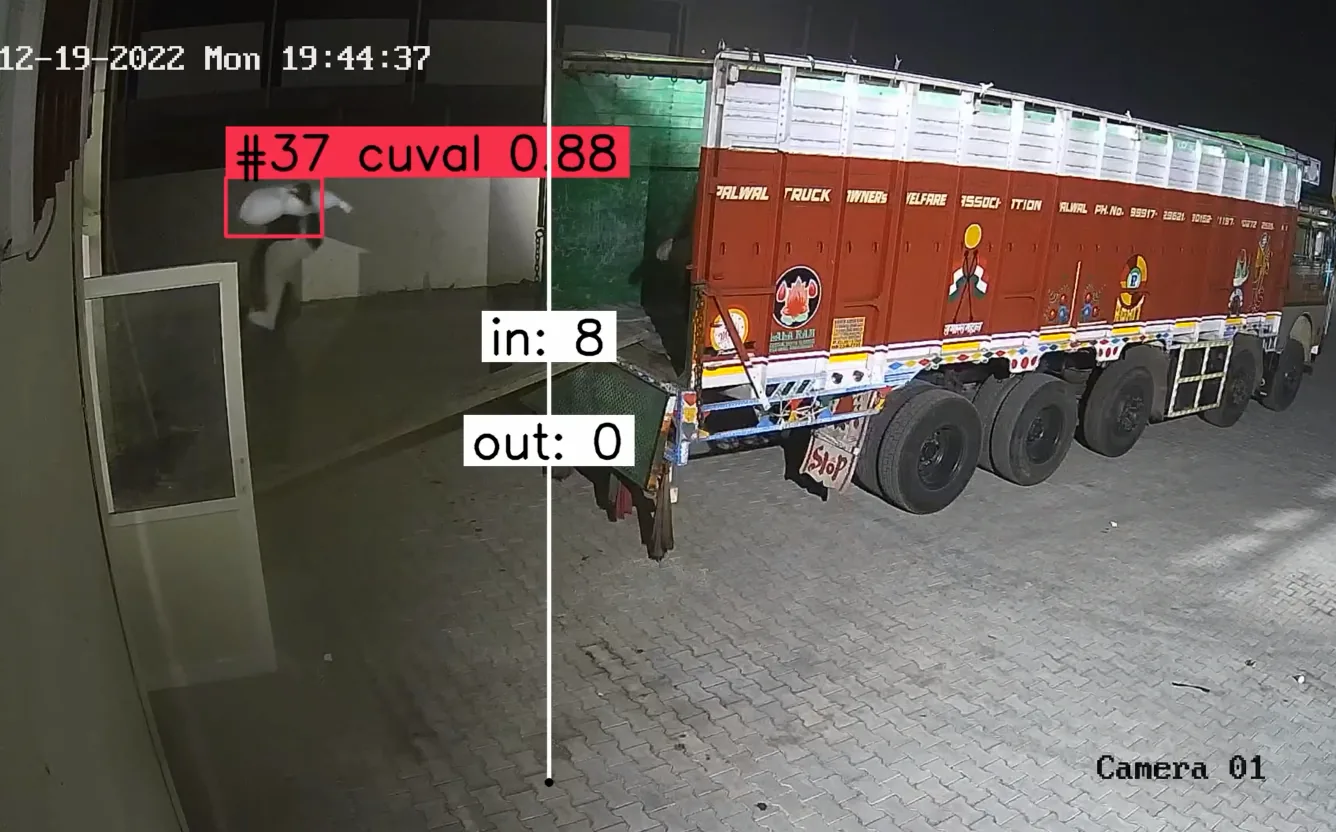
Counts at docks and gates
People counting records movement in and out across a line in the camera view. It applies at docks, gates and entrances, and the counts appear on live dashboards.
In the yard, vehicle analytics adds classification, direction, dwell and parking. At the gate, number-plate recognition keeps a log of plate reads with the time and the gate. Object detection can flag a missing object or an unauthorised removal.
All analytics modules
Each module is a purpose-trained deep-learning model with its own rules engine. Modules are chosen per camera and can be combined.
| Module | What it detects | Typical uses |
|---|---|---|
| Intrusion detection | A crossing of a tripwire line, or entry into a restricted zone | Perimeters, restricted areas, premises after hours |
| Crowd monitoring | Crowd density, flow and suspicious behaviour | Terminals, station platforms and concourses, public areas |
| Object detection | Abandoned objects, missing objects and unauthorised removal | Unattended baggage in terminals, watching over assets |
| Vehicle analytics | Vehicle class, direction, dwell and parking, with under-vehicle inspection | Gates, yards, parking areas, high-security entrances |
| Face recognition | Faces, matched in real time against staff, VIP or watchlist databases, with age and gender demographics | Watchlist alerts, recognising staff and VIPs |
| Fire and smoke | Visible flames and smoke | Industrial plants and warehouses |
| PPE compliance | A missing hard hat, vest, gloves or mask | Production lines and shop floors |
| Heatmap and dwell | Movement density and dwell time across a floor | Store layout, staffing and merchandising |
| Helmet and violations | Riders without helmets, triple riding and wrong-way driving | Highway and junction enforcement |
| People counting | Movement in and out across a line, in both directions | Gates, docks and store entrances |
| Loitering detection | A person who stays in a sensitive zone beyond a set time | Perimeters and sensitive zones |
| Video synopsis | Not a detector. It condenses hours of recorded footage and lets operators search by class, colour, direction or time | Reviewing footage after an incident |
These modules are part of AI Video Analytics. Number-plate recognition is a separate product, ANPR and Vehicle Intelligence. Face Recognition is also offered as a product of its own.
Tuning for the site
Modules are set up camera by camera, first in a pilot on a small set of cameras and then at scale-out. These controls fit a rule to the scene.
- Zones
- Each camera has its own detection zones, so a rule applies only to the part of the view that matters: a fence line, a doorway or a dock.
- Schedules
- A rule can follow a timetable. An intrusion rule, for example, can run only when the site is closed.
- Confidence thresholds
- Each camera has its own threshold for how sure a model must be before it raises an alert. In general, a higher threshold means fewer false alarms but more missed events, so the setting is a choice to make with the site team.
- Scene calibration
- False-alarm suppression works with scene calibration, which fits a module to the camera's own view. Calibration is part of scale-out.
- Custom model training
- Models can be trained for objects that are specific to one site.
- Field conditions
- Models are trained and hardened for real field conditions: glare, dust, monsoon rain, low light, dense crowds and mixed camera quality.
See the modules on your own footage
Send a sample clip or arrange a live demo. We run the modules you choose on the scenes that matter to you.